

In continuous casting and hot rolling processes, the surface of steel slabs, billets, or blooms inevitably forms a layer of iron oxide scale. This scale must be removed before further processing to prevent surface defects and roll damage. The casting scale breaker roll – also known as a descaler roll or Scale Breaker Roller – is a critical component that mechanically fractures and removes scale from the hot metal surface. This article explains the working principle, material requirements, design features, and maintenance of scale breaker rolls.

A casting scale breaker roll is a cylindrical component installed in the scale breaker section of a continuous casting machine or hot rolling mill. It typically consists of a forged or cast steel roll body with specially designed surface features – such as ribs, grooves, or segmented rings – that apply localized pressure to the scale layer. As the hot slab passes between a pair of scale breaker rolls (upper and lower), the mechanical action cracks the brittle scale, which is then removed by high-pressure water jets.
Unlike conventional conveyor rolls, scale breaker rolls are designed to withstand high temperatures, thermal shock, and abrasive wear caused by hard oxide particles.
The process follows these steps:
The hot cast slab (typically 800–1200°C) exits the caster or reheat furnace.
A pair of scale breaker rolls, positioned opposite each other, grip the slab.
The roll surface features – raised ribs or eccentric segments – create high local stress on the scale layer.
The brittle scale fractures into small pieces.
High-pressure water nozzles (100–400 bar) flush away the loose scale.
The clean slab surface proceeds to the next rolling stand.
The rolls themselves are often water-cooled internally to maintain structural integrity at extreme temperatures.
The scale-breaking action comes from the roll surface geometry:
Axial ribs – continuous or interrupted ribs running along the roll length
Spiral grooves – helical pattern that provides constant scale fracture
Segmented rings – individually replaceable rings with raised teeth
Eccentric or polygon profiles – create a cam-like action for aggressive scale removal
The choice depends on slab width, scale thickness, and desired surface quality.
Scale breaker rolls operate in intense heat. Most designs include:
Axial bore through the roll center for water flow
Spiral cooling channels near the surface for uniform temperature distribution
Rotary joints at both ends to connect cooling water supply
Effective cooling prevents roll deformation, surface cracking, and premature wear.
The roll material must balance hot hardness, thermal fatigue resistance, and wear resistance. Common materials include:
| Material | Properties | Typical Application |
|---|---|---|
| Heat-resistant alloy steel (e.g., 42CrMo4) | Good toughness, moderate heat resistance | Lower temperature (<800°C) |
| High-chromium white cast iron (15–25% Cr) | Excellent wear resistance, moderate thermal fatigue | Medium duty |
| Nickel-chromium-molybdenum alloy | High hot hardness, thermal shock resistance | High temperature (>1000°C) |
| Cobalt-based superalloy (e.g., Stellite cladding) | Extreme hardness, scale spalling resistance | Heavy duty, long life |
For most continuous casting applications, high-chromium white iron or Ni-Cr-Mo alloy rolls are preferred.
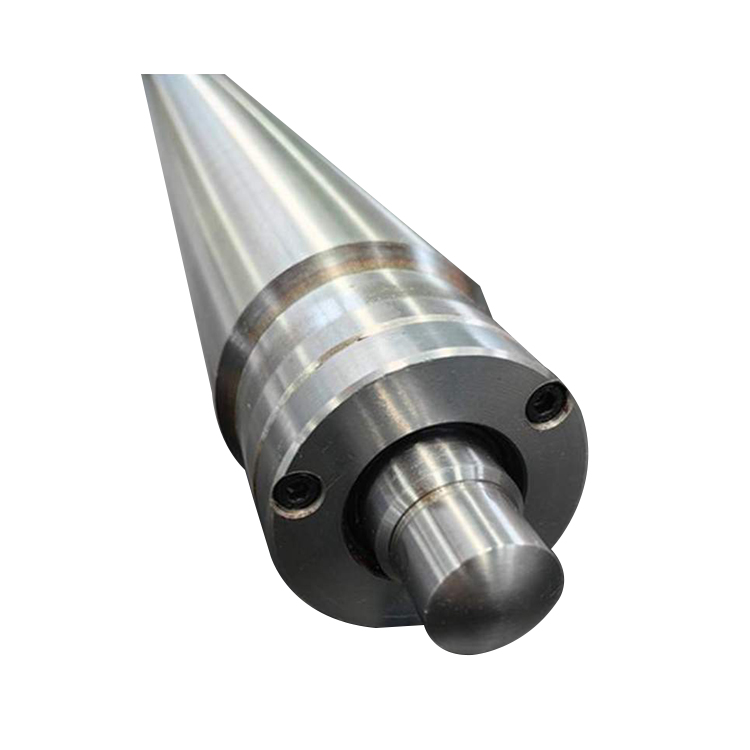
Scale breaker rolls are typically supported by:
Spherical Roller bearings – accommodate misalignment and heavy radial loads
Water-cooled bearing housings – protect bearings from radiant heat
High-temperature grease or circulating oil lubrication
Continuous casting machines – slab, bloom, and billet casters
Hot strip mills – descaler section before roughing stands
Plate mills – scale breaking prior to rolling
Steel rebar mills – billet conditioning
Non-ferrous hot rolling – copper or aluminum slab descaling
When choosing scale breaker rolls for your mill, consider the following.
Width, thickness, and weight determine roll length, diameter, and load capacity.
Higher temperatures require nickel‑ or cobalt‑based alloys and more aggressive internal cooling.
Thick, tenacious scale may need segmented or eccentric roll designs. Light scale can be handled with ribbed rolls.
Faster line speeds require rolls with balanced construction and robust bearing support.
Aggressive patterns remove scale effectively but may leave marks on softer slabs. Fine patterns provide gentler action.
Segmented rolls allow replacement of worn rings without removing the entire roll body, reducing downtime.
Proper installation ensures effective scale removal and long roll life.
Roll gap setting – the distance between upper and lower rolls must be carefully adjusted. Too tight may damage the slab; too loose reduces scale-breaking efficiency.
Parallelism – both rolls must be parallel across the slab width to avoid uneven scale removal.
Cooling water connection – verify internal water flow before operation. Use flow meters to detect blockages.
Bearing clearance – follow manufacturer specifications for preload or clearance at operating temperature.
Cooling water flow and temperature (outlet water should not exceed 60–80°C)
Unusual noise or vibration from bearings
Visual inspection for roll surface cracks or spalling
Measure roll diameter at multiple points to monitor wear
Check bearing housing temperatures with an infrared gun
Inspect water rotary joints for leakage
Remove rolls for thorough inspection
Non-destructive testing (magnetic particle or dye penetrant) for surface cracks
Rebuild or replace worn rings or sleeves
Rebalance the roll assembly if material has been removed
Diameter reduction exceeding 15–20% of original
Deep surface cracking beyond the hardened layer
Bearing seizure or shaft bending
| Failure Mode | Cause | Prevention |
|---|---|---|
| Thermal fatigue cracking | Repeated heating and cooling | Improve internal cooling, use more thermal-resistant material |
| Abrasive wear | Hard scale particles rubbing on roll surface | Use high‑chromium or clad material, maintain water descaling |
| Spalling (surface flaking) | Stress concentration, material embrittlement | Avoid overheating, follow warm‑up procedures |
| Bearing failure | Water ingress, high temperature, overload | Seal bearings, use water‑cooled housings, correct lubrication |
| Roll bending | Excessive load or thermal gradient | Reduce load, improve cooling uniformity |
Improved surface quality – clean slabs reduce rolling defects and scrap
Longer roll life – premium materials and design reduce replacement frequency
Lower maintenance costs – less downtime for roll changes
Energy savings – efficient scale removal reduces rolling load on subsequent stands
Consistent production – predictable wear patterns allow planned maintenance

The casting scale breaker roll is a seemingly simple but highly engineered component that plays a vital role in steel and non‑ferrous hot rolling. By understanding the relationship between roll surface pattern, material selection, internal cooling, and operating conditions, mill operators can significantly improve descaling efficiency and reduce operating costs. Regular inspection and proper alignment are just as important as initial selection.
When investing in scale breaker rolls, prioritize proven materials (high‑chromium iron or Ni‑Cr‑Mo alloys), effective internal cooling design, and a surface pattern matched to your product mix. The result will be cleaner slabs, longer roll life, and smoother rolling operations.
Need technical assistance or custom‑designed scale breaker rolls for your casting or rolling mill? Contact our engineering team to discuss your slab dimensions, temperature range, and production goals.
 Contact person:Mr.Wu
 Phone:+86 18602539156
 Email:wuqi231138@126.com
This website uses cookies to ensure you get the best experience on our website.
 Español
 Pусский
 Indonesia
 Tiếng Việt


Comment
(0)