

In the metal processing and rolling process system, straightening rollers are key equipment to ensure the accuracy and quality of metal materials. Its core function is to eliminate irregular shapes such as bending, warping, and wavy shapes that occur in metal materials during rolling, cooling, or transportation through the roll correction mechanism, ensuring that the surface flatness and dimensional accuracy of the material meet the requirements of subsequent processing. With the continuous improvement of product quality requirements in the metal processing industry, the design accuracy, adaptability, and operational stability of Straightening Rollers have been given higher expectations, and are widely used in multiple core processing fields such as steel, non-ferrous metals, and automotive parts, becoming an indispensable and important support for the deep processing of metal materials.
The core scientific principle of straightening technology lies in the exquisite control of the elastic-plastic deformation of metal materials. When a metal material with curvature defects continuously passes through a set of Rollers arranged according to a specific pattern, it will undergo repeated alternating bending deformation. The straightening roller, through precise control of the pressing amount, causes the surface stress of the material to exceed its yield limit, resulting in plastic deformation, while the core of the material is mainly in an elastic deformation state. After the material separates from the roller gap, the elastic recovery of the core is constrained by the surface layer that has already undergone plastic deformation, thereby reducing or eliminating the original macroscopic curvature defects.
Based on the differences in application scenarios and correction needs, Straightening rollers can be divided into multiple types, each with its own characteristics in structural design and functional focus. Among them, roller straightening machines are the most common type, which can be divided into two roller straightening machines, multi roller straightening machines, etc. according to the arrangement of roller shafts. Multi roller straightening machines are widely used in high-precision processing scenarios such as thin plates and strips due to their more precise correction capabilities; Straightening rollers for pipes adopt an arc-shaped roller surface design, which is suitable for the circular cross-section of pipes.
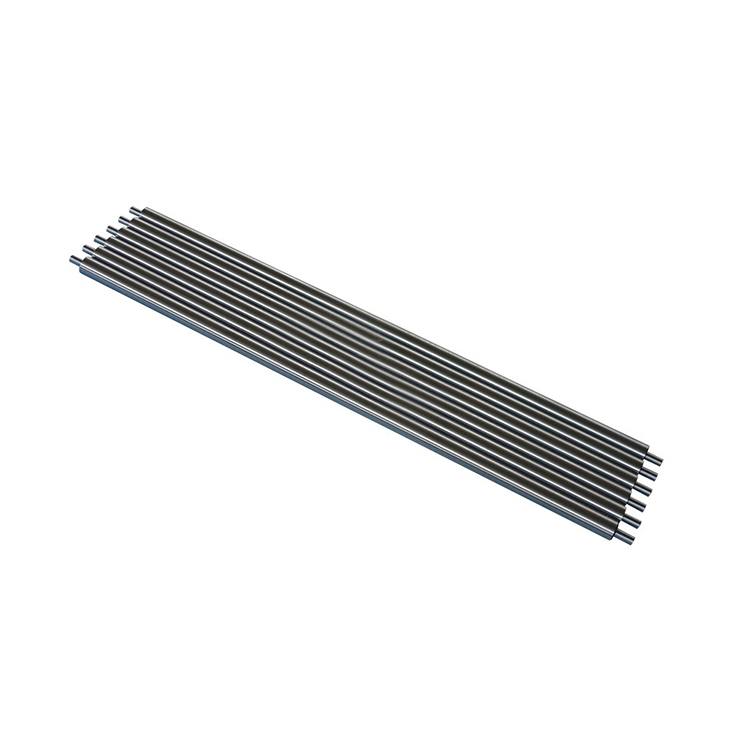
During the correction process, it can avoid damaging the inner wall of pipes and ensure the roundness and straightness of pipes; In addition, customized Straightening rollers are available for the special cross-sectional shapes of special-shaped materials. Through personalized roller profile design, precise correction of complex shaped special-shaped materials can be achieved. Regardless of the type, the core design logic revolves around "precise pressure and controllable deformation" to ensure that the correction effect is guaranteed while minimizing damage to the material surface.
The application of straightening rollers covers multiple key links in metal processing, providing guarantees for high-quality production in different industries. In the steel industry, hot-rolled or cold-rolled steel plates and strips are prone to warping and deformation during the cooling process. Through precise correction by Straightening rollers, the flatness of the plate can be ensured to meet the requirements of subsequent cutting, stamping, and other processing, thereby improving the qualification rate of steel products; In the field of automobile manufacturing, metal components such as automobile frames and chassis parts have extremely high requirements for straightness and flatness.
The straightening process of Straightening rollers directly affects the assembly accuracy of components and the overall performance of the vehicle; In the field of non-ferrous metal processing, lightweight metal materials such as aluminum and copper are prone to deformation during processing due to their strong ductility. Specialized Straightening rollers can achieve gentle correction of these materials, avoiding fracture or surface scratches caused by excessive pressure; In addition, Straightening rollers play an indispensable role in industries such as pipe processing and hardware products, becoming a key process for improving product quality.
With the development of the metal processing industry towards high precision and intelligence, Straightening rollers are also constantly iterating and upgrading. On the one hand, by using high-strength wear-resistant materials and precision machining processes, the service life and correction accuracy of the roller shaft can be improved; On the other hand, the integration of intelligent technology has become an important trend. By installing sensors to monitor real-time pressure, temperature, and material deformation data during the correction process, combined with intelligent control systems to automatically adjust equipment parameters, the automation and precision of the correction process can be achieved.
In the future, Straightening rollers will further adapt to the personalized needs of emerging fields such as new energy vehicles and high-end equipment manufacturing. While improving the quality of metal material processing, they will help industrial production transform towards high efficiency, energy conservation, and intelligence.
 Contact person:Mr.Wu
 Phone:+86 18602539156
 Email:wuqi231138@126.com
This website uses cookies to ensure you get the best experience on our website.
 Español
 Pусский
 Indonesia
 Tiếng Việt


Comment
(0)