

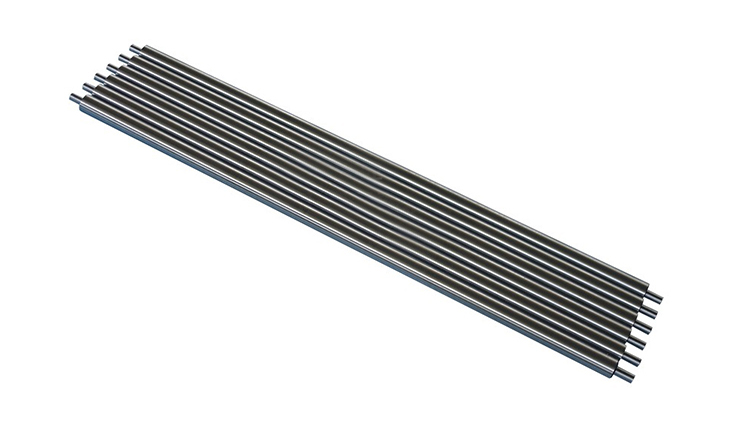
In industrial fields such as steel and non-ferrous metal processing, the straightness accuracy of metal profiles directly determines the quality and performance of subsequent processed products. straightening rollers, as the core working components of metal straightening equipment, undertake the key mission of correcting deformation defects such as bending and twisting of metal profiles. Through precise squeezing and guiding, they restore the ideal straightness of metal profiles, laying the foundation for subsequent cutting, welding, assembly and other processes. Whether dealing with steel plates, steel pipes, steel bars, aluminum profiles, copper profiles and other materials, stable performance Straightening Rollers are the core support to ensure metal processing accuracy and improve product qualification rates.
The essence of a straightening Roller is a precision mechanical system that applies controllable bending. Its working principle does not rely on brute force flattening, but is based on the theory of elastic-plastic deformation: the strip or rod is repeatedly subjected to alternating bending stresses in multiple staggered roller gaps. This repeated bending causes the surface fibers of the material to undergo tension and compression. When the stress exceeds its yield limit, permanent plastic deformation occurs; By precisely controlling the bending amount, compression amount, and bending frequency, the residual stress inside the material is ultimately balanced, and the overall state is achieved in a straight state. The arrangement of Straightening rollers - the "staggered roller type" in which the upper and lower rollers are arranged alternately, or the "pressure straightening type" in which all rollers are located on one side - as well as parameters such as roller diameter and roller spacing, need to be scientifically calculated and selected based on the material, cross-sectional shape, thickness, and initial curvature of the material.
From the perspective of structural design, the design of Straightening rollers needs to fully adapt to the characteristics and correction requirements of different metal profiles, presenting diverse structural forms. Common straightening rollers often adopt a multi roller layout, divided into upper roller group and lower roller group, to achieve the correction of metal profiles through the relative compression of the upper and lower rollers. According to the different correction materials, the diameter, distance, and surface shape of Straightening rollers will be designed accordingly. For sheet materials, flat roller Straightening rollers are usually used, with a smooth and even surface to ensure that the sheet surface is not damaged; For materials such as pipes and profiles, special-shaped straightening rollers are used, with roller surfaces that conform to the cross-sectional shape of the material, achieving precise correction in all directions. At the same time, the material of Straightening rollers is mostly high-strength alloy structural steel, which has undergone heat treatment processes such as quenching and tempering, and has good wear resistance, compression resistance, and deformation resistance. It can withstand the huge extrusion force generated during the correction process.

Straightening rollers have a wide range of application scenarios covering multiple sub fields of metal processing, becoming a key link in ensuring product quality. In the steel production industry, Straightening rollers are used in equipment such as steel plate straightening machines and steel bar straightening machines to correct defects such as steel plate bending and steel bar twisting that occur during hot rolling and cold rolling processes, providing high-precision steel raw materials for industries such as construction and machinery manufacturing; In the field of non-ferrous metal processing, it is suitable for straightening equipment for aluminum and copper profiles, handling deformation problems that occur during extrusion and stretching of profiles, and ensuring the accuracy requirements of profiles needed in fields such as doors and windows, aerospace, etc; In the pipe production industry, straightening rollers are used for straightening steel pipes and stainless steel pipes to ensure the straightness and roundness of the pipes, meeting the needs of pipeline transportation, mechanical processing, and other scenarios. In addition, Straightening rollers also play an important role in fields such as automotive parts processing and hardware production, helping to improve the machining accuracy of various metal components.
Straightening rollers, these solid cylinders arranged side by side on the production line, are the physical embodiment of the spirit of "striving for excellence" in industrial manufacturing. They intervene with precise mechanical calculations, gently yet firmly guiding materials back to the purity of geometry. What is accomplished between the roller seams is not only a change in shape from curved to straight, but also a leap in quality from rough to precise. It is the last finishing stroke that endows industrial products with regularity, beauty, and functional reliability. They are unknown, but they are always the hammers of precision manufacturing in music movements, ensuring that every note falls in the correct position.
 Contact person:Mr.Wu
 Phone:+86 18602539156
 Email:wuqi231138@126.com
This website uses cookies to ensure you get the best experience on our website.
 Español
 Pусский
 Indonesia
 Tiếng Việt


Comment
(0)