

Many maintenance teams simply replace worn rolls without fixing the root causes, leading to repeated failures and unnecessary operational costs. A properly maintained wet scale breaking support roll delivers consistent pressure distribution for continuous descaling work. Uneven wear almost always stems from uncalibrated equipment parameters, harsh wet working conditions, and irregular daily maintenance routines in metal rolling workshops.
Standard Operational Parameters for Wet Descaling Support Rolls
Wet scale breaking environments combine high-pressure water impact, oxide scale abrasion, and alternating hot and cold temperatures, making roll wear far more complex than ordinary dry rolling conditions. B-end technical and procurement teams need clear industry benchmark parameters to judge operational rationality and analyze abnormal wear problems. The following standardized values are widely adopted in modern hot rolling mills to ensure stable descaling performance and uniform roll stress.
Parameter Item | Industrial Standard Range | Wear Control Effect |
|---|---|---|
Working Surface Hardness | HS 85–92 | Resists abrasive wear from oxide scale particles and water impact |
Allowable Pressure Deviation | ≤ 5% Full Length Uniformity | Avoids localized overpressure and concentrated wear zones |
Descaling Water Pressure | 18–22 MPa | Balances scale removal efficiency and surface scouring wear |
Roll Parallelism Tolerance | ≤ 0.03mm/m | Ensures full linear contact and even stress distribution |
Operating Temperature Range | 40–70℃ Stable Working Temp | Prevents thermal deformation and inconsistent hardness loss |
Most uneven wear cases occur when actual operating data deviates from these standard ranges. Excessive pressure deviation, poor parallelism, and unstable water pressure create fixed high-friction zones on the roll surface. Under long-term repeated descaling cycles, these zones wear faster, forming obvious concave and convex differences across the roll body.
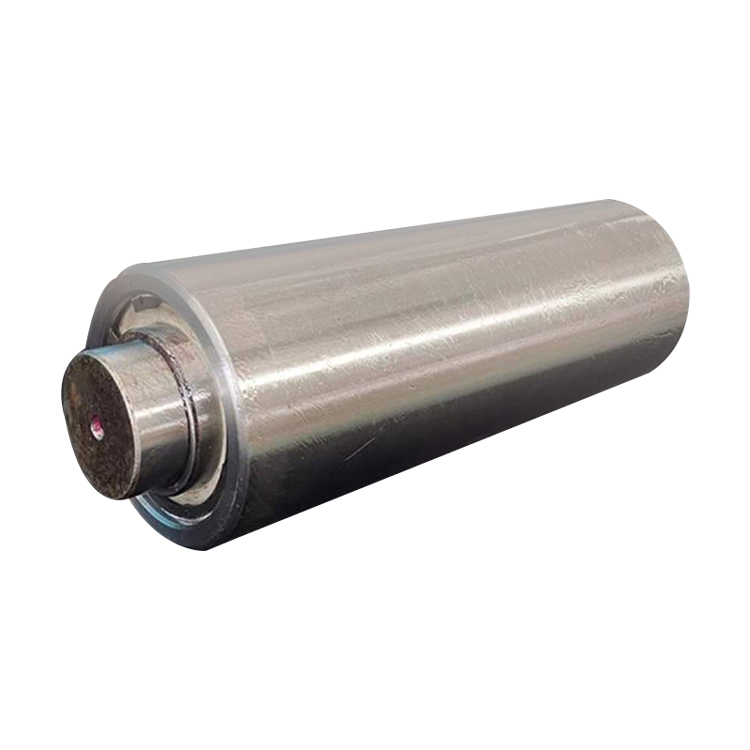
Key Root Causes of Uneven Roll Wear in Wet Descaling Lines
1. Shaft Misalignment and Poor Parallelism
Shaft deformation, loose bearing seats and inaccurate calibration are the most common mechanical causes of uneven wear. When the support roll loses standard parallelism with the work roll, contact pressure is no longer evenly distributed along the full length. One side or the middle section bears most of the extrusion force and friction load during descaling operation.
With continuous high-speed strip movement and water scale scouring, overloaded areas wear rapidly, while lightly contacted areas remain relatively intact. This forms typical partial wear defects. Many factories ignore minor parallelism errors during daily inspections, allowing small deviations to evolve into serious roll surface irregularities within a short production cycle.
2. Asymmetric Oxide Scale Accumulation and Abrasion
Wet descaling working conditions contain a large number of fine iron oxide particles mixed in circulating water. These hard scale particles act as abrasive powder during continuous production. If the water circulation filtration system is inefficient, scale residues will unevenly adhere to local roll surfaces or accumulate on one side of the rolling gap.
Asymmetric abrasive media creates localized intensified friction, resulting in non-uniform material loss on the roll surface. Unlike regular mechanical wear, scale-induced uneven wear develops quickly and easily forms strip-shaped wear grooves, which further affect the flatness of steel strips after descaling.
3. Unstable Thermal Distribution and Local Thermal Deformation
Hot rolling brings continuous high-temperature strip heat transfer, while wet descaling water provides rapid cooling. Uneven water nozzle spraying and inconsistent strip temperature distribution lead to unbalanced thermal exchange on the roll surface. Partial overheating reduces local material hardness, making these areas more susceptible to abrasion and deformation.
Long-term uneven thermal cycling causes micro thermal deformation, changing the original linear contact state. Deformed rolls produce new pressure concentration points, creating a vicious cycle of deformation and accelerated wear that severely affects production stability.
4. Improper Lubrication and Seal Failure
Poor sealing performance allows scale-containing cooling water to penetrate into bearing and contact areas, destroying normal lubrication conditions. Local lubrication failure increases dry friction and abrasive wear in fixed positions. Without timely maintenance, these wear spots gradually expand and develop into large-area uneven wear.
Practical Solutions to Avoid Uneven Wear
Eliminating uneven wear relies on standardized daily management rather than passive replacement. Regular parallelism calibration and pressure balance testing ensure uniform contact stress. Upgrading water filtration systems reduces abrasive scale residues in circulating water. Timely inspection and replacement of aging seals maintain stable lubrication and prevent water contamination.
Regular offline precision grinding can repair minor irregular wear surfaces, restoring the original linear contact accuracy. These simple but effective maintenance measures greatly extend the service cycle of the roll and stabilize descaling production quality.
FAQs About Uneven Wear on Wet Descaling Support Rolls
1. How to quickly confirm uneven roll wear during daily production?
You can detect early wear signs by observing finished steel surface consistency and measuring roll diameter at multiple points. Obvious strip descaling differences and more than 0.1mm diameter deviation across roll length confirm uneven wear that requires timely calibration and grinding.
2. Is scale abrasion the main factor causing irregular roll surface loss?
Scale abrasion accelerates wear speed, but mechanical misalignment and unbalanced pressure distribution are the fundamental causes of uneven wear. Scale particles only amplify existing stress concentration problems, leading to faster localized material loss.
3. How often should parallelism calibration be performed?
For continuous hot rolling production lines, full parallelism and pressure calibration are recommended every 15 to 20 production days. Regular calibration effectively avoids accumulated deviation and prevents premature uneven wear failure.
4. Can uneven worn rolls continue running after simple polishing?
Slight surface irregularities can be repaired by precision grinding. Severe uneven wear with obvious deformation and diameter deviation must be corrected thoroughly. Simple surface polishing cannot fix internal stress imbalance and will cause repeated wear problems.
 Contact person:Mr.Wu
 Phone:+86 18602539156
 Email:wuqi231138@126.com
This website uses cookies to ensure you get the best experience on our website.
 Español
 Pусский
 Indonesia
 Tiếng Việt


Comment
(0)